Tripoli — 2016
FROM THE EYE OF AN IMMIGRANT EXTENSIONS
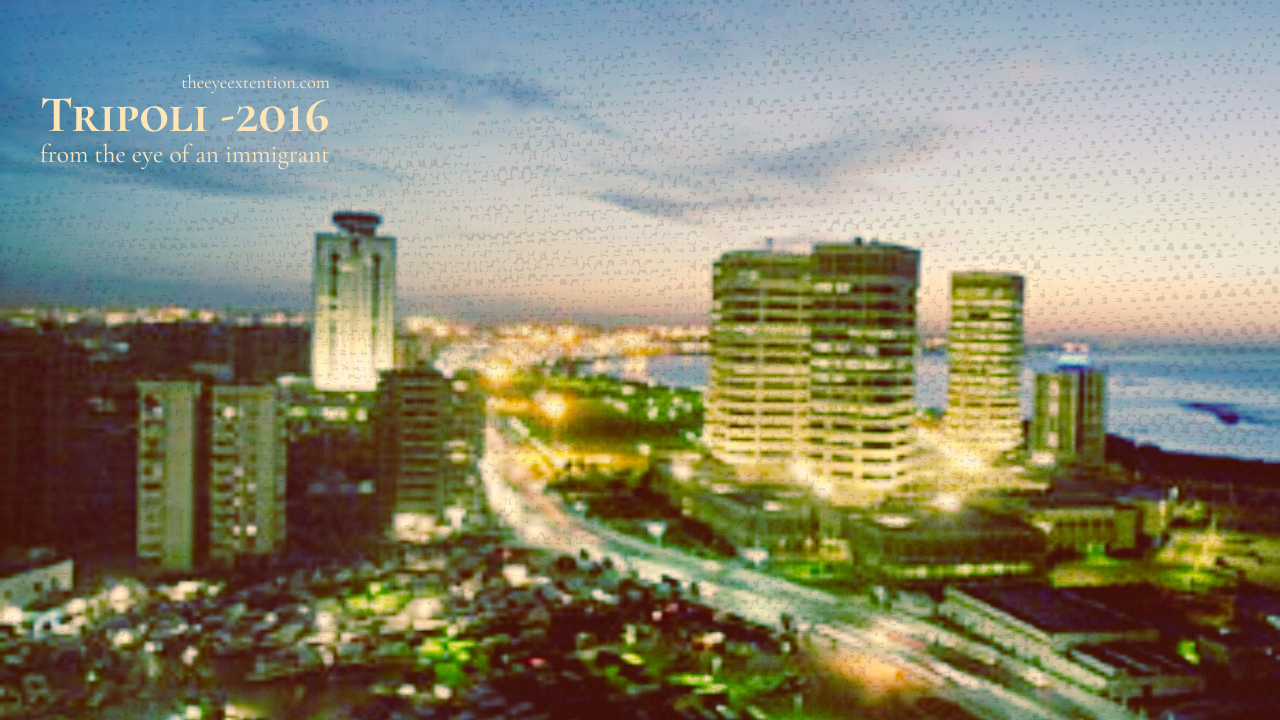
From Tripoli, you could see the sea.
It didn’t feel far.
It felt attached to the sky — like the city was standing between two things that could erase you without touching you first.
That was the first lie Tripoli told me: that distance meant safety.
The streets were always empty.
Not quiet.
Empty.
There’s a difference.
Quiet can rest.
Empty just waits.
Houses were punctured with holes — bullet holes. Some small and neat, others torn open, wide enough to tell you the weapon was heavier than the story anyone would ever admit out loud. Nobody explained anything. You learned by looking. Then you learned by not looking too long.
In Tripoli, curiosity was expensive.
I worked in the market pushing a wheelbarrow. That was the job. Push. Wait. Get paid — if the person came back. Sometimes they did. Sometimes they disappeared into the city like smoke. You didn’t ask questions. You just learned the rhythm of absence.
Kids ran around with toy guns that felt too real. Plastic shaped like memory. Nobody laughed. Not because they didn’t know how — but because laughter there had a way of sounding like disrespect.
I learned numbers in Arabic before I learned words.
Not greetings. Not sentences.
Numbers.
Numbers helped you survive.
Prices. Distances. Time.
Numbers made things negotiable. Words made things dangerous.
There was a shop near our camp. Every time we walked in, the seller covered his nose with a cloth. I used to wonder why. There was no way I smelled that bad.
Looking back, there’s a very high chance we did.
Tripoli doesn’t let you notice yourself until much later.
Bread mattered in Tripoli.
Early in the morning, if you moved around the city, you’d see bread placed carefully in the corners of houses. Not trash. Never trash. Bread wasn’t thrown away. Someone told us that once — quietly, seriously — like they were passing down a law older than religion.
After that, whenever we saw bread abandoned, we rushed it home and ate like it was normal. Like hunger hadn’t already trained us to move fast.
Tripoli was where I got addicted to a cigarette called ORIS. I remember the name. I remember the feeling more — the way smoke slowed time just enough to make the day bearable. Addiction there wasn’t about pleasure. It was about pause.
We celebrated my birthday with zero beers.
0.0 beer. Non-alcoholic.
Beer was illegal. Celebration wasn’t.
There was a strange freedom in that contradiction.
There was a place called Grigarage. It felt like a city center pretending to be alive. Me and Izzy went looking for alcohol. We found a house instead. Inside, they served dogoyaro — bitter leaves from a Nigerian tree — soaked in something strong called kien kien. It burned and stayed.
Later, we realized the African girls there were working as prostitutes.
That discovery didn’t explode into drama. It turned into a quiet war between me and Izzy. A disagreement with no winner. Nobody loses cleanly either. Tripoli had a way of leaving you with arguments that never finished.
Our driver was a Libyan man in his forties. Taxi driver. Quiet. One of the best people I met in that country. When fighting or riots broke out, he sent screenshots of the city like weather updates.
Don’t go out today.
That was care, Tripoli-style.
There was a code everyone knew:
If a car stops suddenly near you — you run.
No thinking.
I remember running once.
I don’t remember where to.
A red dusty car. Sudden brakes. Too close. Too fast.
The body moves before the mind decides.
One day I watched football at Grigarage. Manchester United won. Rashford scored. I was over the moon — not because of football, but because normal Arab guys were arguing like nothing else existed.
That argument gave me joy.
For a few minutes, the world forgot us.
And being forgotten felt like relief.
I ate what I still consider the best kebab in the world.
Maybe it was hunger.
Maybe relief.
Maybe because, for a few minutes, nothing was chasing us.
Tripoli doesn’t teach lessons.
It doesn’t wrap itself into stories with endings.
It just gives you days that stay.
Days that follow you long after the sea decides to introduce itself properly — when silence becomes heavier, when engines stop, when fear learns how to whisper instead of shout.
That was Tripoli.
Not a metaphor.
Not a warning sign.
Just a place where survival learned how to look normal.